Top 15 Office 365 to Office 365 Migration Tools (2026-27 Enterprise Guide)


The data migration is the responsibility of the admin, and they have to accomplish it carefully. Microsoft also provides manual methods, but migrating data manually is risky and requires extensive expertise and experience. Therefore, the admin needs to use the vendor migration tools. We are reviewing the top 15 Office 365 to Office 365 migration tools.
Office 365 is the most used productivity suite by organizations. However, moving from one subscription plan to another is common in organizations. Microsoft provides a new tenant whenever you upgrade your subscription plan from Business to E3 or another. Therefore, the data from the old tenant should be migrated into the new tenant to avoid data loss and ease compliance.
What is Migration in Office 365?
In Office 365, migration is the process of transferring configurations, data, and applications from one tenant to another. Email, calendars, SharePoint sites, OneDrive files, and Teams data are all included in this. To reduce disturbance and ensure an effortless transition, smooth migration requires careful planning, assessment of dependencies, and compliance with recommended standards.
What is the Need for Office 365 to Office 365 Migration?
The need for Office 365 to Office 365 migration arises from various business scenarios:
- Restructuring: Combining multiple Office 365 tenants into a single tenant due to mergers and acquisitions in organizations.
- Geographical Shift: To improve service or comply with local requirements, organizations moving into new regions may need to set up new Office 365 tenants.
- Cloud Optimisation: Changing Office 365 plans or providers can help you save money, increase scalability, and take advantage of cutting-edge capabilities.
- Improved Cooperation: Across departments and teams, smooth communication and cooperation are made possible by a single Office 365 environment.
- Data Security and Compliance: Moving to a secure Office 365 environment will ensure data security and compliance with legal standards.
Let’s understand the benefits of migration. After that, we will review the top 5 Office 365 to Office 365 migration tools. If you want to know more about how to perform Office 365 to Office 365 migration, click on the link.
What are the Benefits of Office 365 to Office 365 Migration?
- Operational efficiencies can be smoothly increased by Migrating from Multiple Office 365 tenants to a single, integrated environment.
- Centralizing management, streamlining IT administration duties, and doing away with the need to maintain several sets of user accounts, rights, and configurations lowers complexity.
- Processes are streamlined; there are fewer operational bottlenecks as a result of this consolidation, and organizational efficiency is increased overall.
- Office 365 provides scalability, allowing organizations to simply increase or decrease resources based on changing needs without incurring major IT expenses.
- Migrating to a scalable Office 365 setup enables organizations to respond rapidly to swings in user demand, seasonal peaks, or corporate expansions.
- The flexibility allows for more efficient resource allocation, cost-effective administration of IT resources, and better alignment of IT investments with organizational growth plans.
How We Evaluated the Best Migration Software
To determine the best Office 365 migration tools for 2026, we tested each software against our meticulously created “5-point testing criteria”. These five-point testing criteria are purely based on strict enterprise parameters and real-world Microsoft 365 administrative challenges.
#1: Workload Fidelity & Completeness
Migrating Exchange mailboxes is straightforward; moving modern collaborative workspace is not. We strictly discarded tools that failed to accurately migrate Microsoft Teams private channels, chat histories, OneNote notebooks, and sophisticated SharePoint permissions.
#2: Microsoft Graph API Throttling & Speed
The best tenant-to-tenant (T2T) migration tool must have the bandwidth to handle Microsoft’s strict HTTP 429 (Too Many Requests). Therefore, we carefully evaluated how effectively each third-party tool manages Microsoft’s HTTP 429 throttling limits during bulk data transfers.
And as Tony Redmond (renowned Office 365 MVP) has highlighted regarding tenant moves, “Given the amount of information accumulated in mailboxes, OneDrive accounts, and Teams chat, the speed of migration is important, and you can’t go any faster than when information stays within Microsoft.”
#3: Delta Sync & Coexistence Capabilities
Since enterprise migrations often take weeks, we prioritized robust “Delta-Sync” features. The best Microsoft 365 migration tools must allow admins to run an initial background copy without disrupting users. It needs to be followed by a rapid incremental sync (delta) during the final cutover migration to capture newly created data in the tenant.
#4: Security and Authentication (Modern Auth)
When evaluating the cross-tenant migration software, we emphasized the security framework used by the software. Tools requiring disabling Multi-Factor Authentication (MFA) or using deprecated Basic Authentication are strictly excluded. Only utilities that utilise secure Azure app registrations, OAuth 2.0, and Application Impersonation (via the principle of least privilege are included.
#5: Administrative Overhead & Support
We reviewed the UI intuitiveness, the precision of pre-migration readiness checks, and post-migration reporting. Also, ensuring whether the vendor provides 24/7 specialised IT support to resolve localized errors.
15 Best Office 365 to Office 365 Migration Tools (Ascending Order)
Here are the 15 best Office 365 to Office 365 migration tools available in 2026 for migrating Microsoft 365 workloads securely with no data loss:
#1: SysTools Office 365 to Office 365 Migration Tool
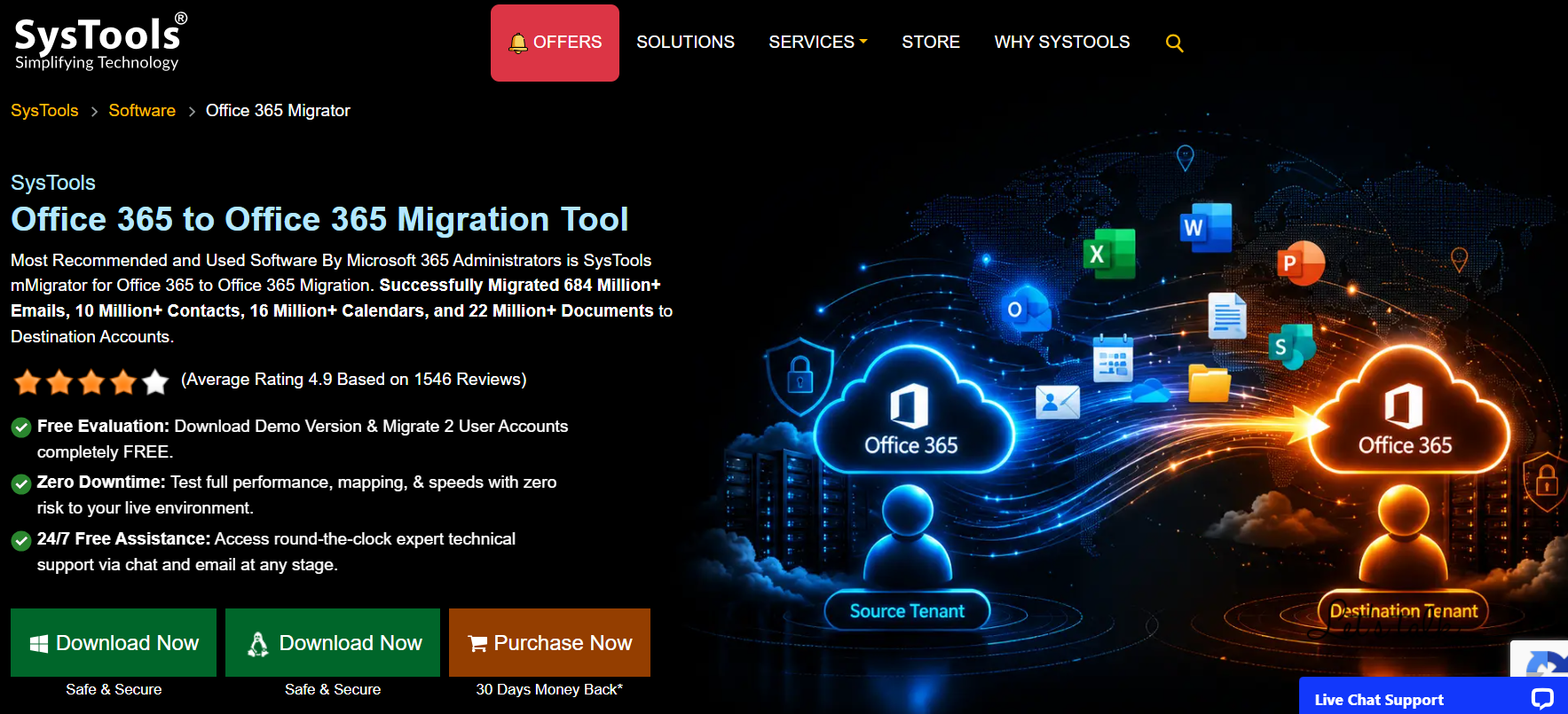
SysTools Office 365 to Office 365 Migration Tool is by far the best Office 365 migration tool available in the market. It guarantees enterprise-grade speed, comprehensive workload support, and transparent pricing with zero downtime.
It securely migrates entire workloads while bypassing strict Microsoft API throttling limits. The packaging of all these remarkable offerings into one ranks SysTools as the top tenant to tenant migration tool.
Target Workloads:
- Exchange Online: Emails (including attachments, metadata, and folder hierarchy), contacts, and calendars (including recurring events and permissions. Public Folders and In-Place Archive are also migrated.
- OneDrive for Business: Documents, files, and folder structures while preserving permissions and metadata.
- SharePoint Online: Document libraries, site pages, generic lists, and custom lists across tenants.
- Microsoft Teams: Teams chats (including private chats), channels, files, and basic collaborative structures.
Key Features:
- Concurrent Batch Processing: Allows multiple user account migrations (batches of 40 users at a time). Enterprise admins can also set priority queues to transfer VIP accounts first.
- Delta Migration (incremental Sync): Offers a “Delta Migration” feature that scans for and transfers only newly arrived data (such as emails received right before the final DNS cutover).
- Precise Data-Ranger Filtering: Provides deep workload customization. Allows the application of date-range filters and particular category selections
- Advanced User Mapping: Enables bulk account matching via CSV upload or by automatically pulling user IDs directly from the source domain.
- Live Migration Dashboard: Features a real-time tracking console. It details data volume transferred, pending queues, active migrations, and detailed error logs.
- Modern Authentication: Ensures that the software never stores admin credentials. Connects the source and destination Microsoft 365 environments using OAuth 2.0 (Modern Authentication) via Azure Directory.
Pros & Cons:
- Hardware Dependent: SysTools Office 365 migration software is a desktop/server-based application, not a 100% cloud SaaS tool. Migration speed will be affected by the host machine’s bandwidth and specifications. For optimal speed, SysTools recommends an 8-core processor and 8 GB RAM minimum.
Pricing:
- Free Tier: SysTools offers a free demo version that allows complete data migration for exactly 2 user accounts to test the environment.
- Paid Licensing: Functions on a highly economical and perpetual license model. The base enterprise bundle costs around $35 ($7/per user). It scales up based on the total user count required.
#2: BitTitan MigrationWiz
BitTitan MigrationWiz is widely regarded as one of the best Office 365 migration software options, especially for Managed Service Providers (MSPs). The most remarkable characteristic of this powerful SaaS platform is that it doesn’t require any local installation. It operates on a 100% serverless SaaS architecture, accessible from any browser. This allows IT teams and Global Administrators to execute complex cross-tenant cloud migrations directly from a centralized web dashboard.
Target Workloads: Exchange Online Mailboxes, OneDrive, SharePoint, Microsoft Teams, Public Folders, and Personal Archives.
Key Features:
- 100% SaaS platform; requires no local agents.
- Offers concurrent mailbox provisioning.
- Teams chat migration (including emojis and GIFs).
- Unlimited data processing using the User Migration Bundle.
- Automated Outlook profile configuration using the DeploymentPro agent.
- Deep PowerShell script integration via customizable “Advanced Options”.
|
Pros |
Cons |
|
|
Pricing: Per-user pricing. The “User Migration Bundle” operates as a single license valid for 12 months ($15/user).
#3: ShareGate
ShareGate is an ultimate, enterprise-ready cloud migration software that heavily prioritizes SharePoint and Teams. It empowers administrators to optimize deeply nested environments. Including flattening legacy permissions and easily managing cross-tenant document migrations. So, if your Microsoft 365 M&A consolidation project demands complex site architecture, go ahead with ShareGate.
Target Workloads: OneDrive, SharePoint Online (Lists, Libraries, Web Parts, Permissions), Microsoft Teams (Channels, Tabs, Planner), OneDrive, and Entra ID.
Key Features:
- Visual, drag-and-drop architectural optimization and flattening.
- Comprehensive pre-migration reporting for identifying orphan users and broken links.
- Automated Microsoft Teams provisioning and cloning across tenants.
- Granular permissions mapping and inheritance remediation.
|
Pros |
Cons |
|
|
Pricing: $,995/year (flat rate for unlimited data volume on a single tenant deployment).
#4: Quest on Demand Migration
Quest on Demand Migration is a corporate-grade, professional Microsoft 365 to Microsoft 365 migration software. Developed specifically for complex Active Directory integrations, it professionally manages directory synchronization, identity coexistence, and massive M365 workload transfers (during large-scale corporate mergers and acquisitions). It is one of the leading tenant to tenant migration suites available.
Target Workloads: Exchange Online, SharePoint Server, Microsoft Teams, Microsoft 365 Groups, Entra ID (Active Directory), device identities, Cloud Drives, Google Workspace, and Slack.
Key Features:
- Complete Active Directory domain consolidation and AD object mapping.
- Domain coexistence features enabling routing between Tenant A and B.
- Deep discovery reporting for pre-migration planning.
- Secure SaaS-based dashboard with RBAC (Role-Based Access Control).
|
Pros |
Cons |
|
|
Pricing: Custom quote-based (Enterprise-tier pricing elevates with organization size).
#5: AvePoint Fly
Require strict compliance for your organization’s workflows? Choose AvePoint Fly. It is a premier Office 365 to Office 365 migration tool that caters to deep pre-migration discovery, effective data governance, and secure tenant to tenant data restructuring for sectors like healthcare, finance, and government.
Target Workloads: Exchange Mailboxes, SharePoint Sites, OneDrive, Microsoft Teams, Planner boards, and M365 Groups with all data classifications and retention labels.
Key Features:
- Diligent pre-migration data analysis.
- Strict compliance logging and auditor-ready export reports
- Automated user mapping and permission restructuring.
- Offline and online (SaaS) deployment options.
|
Pros |
Cons |
|
|
Pricing: Custom quote-based (typically increases based on exact user count or total GB volume).
#6: CodeTwo Office 365 Migration
CodeTwo boasts an incredibly user-friendly interface. This sole feature makes it one of the best tenant migration tools for standard corporate IT Teams. Also, it streamlines cross-tenant migrations with secure OAuth 2.0 integration, visual dashboards, and automated mapping. In a nutshell, it guarantees secure and compliant cloud-to-cloud email and data transfers.
Target Workload: Exchange Online (Mailboxes, Archives, Public Folders), SharePoint document libraries, OneDrive, and Microsoft Teams.
Key Features:
- Rapid source-to-target mailbox pairing via Autodiscover automation.
- Extremely secure modern authentication (OAuth 2.0/MFA) integrations.
- Clear, visual reporting dashboards for real-time tracking.
- Native scheduling for post-migration jobs.
|
Pros |
Cons |
|
|
Pricing: $10 to $15 per mailbox (tiered volume discounts available based on seat count).
#7: SkyKick Migration Suites
SkyKick is a comprehensive solution to migrate between Microsoft 365 tenants, built exclusively for the MSP ecosystem. Positioned as a leading Office 365 migration software, it features a serverless sync engine and automated Outlook reconfiguration. Allowing partners to handle smooth cross-tenant migrations for SMB clients.
Target Workloads: Exchange Online (Emails, Calendars, Contacts), OneDrive for Business, SharePoint Online, and standard Microsoft Teams channel data.
Key Features:
- Server-free synchronization engine running completely in the cloud.
- SkyKick Outlook Assistant (remotely and automatically updates end-user desktop Outlook profiles post-migration).
- MSP-centric multitenant management portal.
- Consolidated backup solutions for post-migration data protection.
|
Pros |
Cons |
|
|
Pricing: $12 to $15 per user (usually sold in bulk via MSP partner channels.
#8: Microsoft Cross-Tenant User Data Migration (Native)
Looking for native, highly secure cross-tenant migration software? Meet Microsoft’s native add-on that keeps data completely within the Azure backbone. It furnishes direct infrastructure-to-infrastructure transfer for enterprise mailboxes and OneDrive data without requiring third-party Graph API limitations.
Target Workloads: Limited to personal user data; Exchange Online Mailboxes and OneDrive for Business files. It cannot migrate SharePoint sites or Teams architecture natively.
Key Features:
- Direct infrastructure-to-infrastructure transfer complete within Azure.
- Bypasses standard third-party Graph API bandwidth throttling/
- Cryptographically secures data in migration without exposing APIs.
- Built-in PowerShell command-line execution.
|
Pros |
Cons |
|
|
Pricing: Requires the particular “Cross Tenant User Data Migration” add-on license (approx. $15/user).
#9: Cloudiway
When it comes to outstanding coexistence capabilities, Cloudiway stands tall. This Office 365 to Office 365 migration tool allows seamless free/busy calendar sharing between separate environments. Ensuring unhindered collaboration during multi-phased enterprise tenant to tenant migrations.
Target Workloads: Exchange Mailboxes, OneDrive, SharePoint, and Teams. Capable of seamlessly migrating legacy data from platforms such as Google Workspace or Lotus Notes directly into the new Microsoft 365 tenant.
Key Features:
- Advanced Free/Busy calendar coexistence connecting two separate tenants.
- Global Address List (GAL) synchronization between Tenant A and Tenant B.
- Cloud-based multitenant migration hub.
- Supports highly complex enterprise routing rules.
|
Pros |
Cons |
|
|
Pricing: The cost starts at $9.50/user for mail-only migrations. $15/user for full M365 ecosystem suites.
#10: Kernel Office 365 Migration
In tenth position, we have Kernel – a highly economical tenant to tenant migration service provider designed for straightforward mailbox-to-mailbox transfers. Kernel is widely considered one of the top cloud migration tools for SMBs on a budget by IT generalists. This is because it handles basic email and OneDrive delta syncs without the sophistication of premium enterprise M&A suites.
Target Workloads: Prioritizes Exchange Mailboxes, Archive Mailboxes, OneDrive User Directories, and standard SharePoint Document Libraries.
Key Features:
- Bulk user mapping via simple CSV batch migration uploads.
- Captures new emails pre-cutover using basic delta sync capabilities.
- Direct, accurate mapping of source to destination folder hierarchies.
- Simple, lightweight desktop GUI.
|
Pros |
Cons |
|
|
Pricing: The pricing of Kernel Office 365 migration starts around $599 for a standard corporate license (limits apply to user/hode counts).
#11: EdbMail Office 365 Migration
EdbMail made to our diligently curated list of best cross-tenant migration tools with its outstanding offering of unlimited data transfer limits per user license. This Microsoft 365 tenant migration tool is optimal for migrating large legacy archives. It also provides powerful modern authentication support and granular folder mapping for intricate cross-tenant projects.
Target Workloads: Heavy Exchange Mailboxes, Public Folders, OneDrive, SharePoint, and standard Microsoft Teams structures.
Key Features:
- Unlimited data transfer per user license (no GB limits).
- Incremental (delta) migration passes to prevent data duplication.
- Full support for modern authentication (OAuth 2.0/MFA).
- Automated and precise folder mapping rules.
|
Pros |
Cons |
|
|
Pricing: The plan starts at $150 for a block of users (tiered pricing based on exact workload requirements).
#12: Shoviv Office 365 to Office 365 Migration
Shoviv is a dedicated, lightweight Office 365 migration software often leveraged for moving complex public folder hierarchies. As a reliable tenant to tenant migration tool, it offers surprisingly fast indexing and legacy PST ingestion capabilities. This attribute particularly makes it the ideal choice for IT administrators executing focused, email-heavy cross-tenant cloud migrations.
Target Workloads: Routes legacy mail data, targeting Exchange Mailboxes, Archive Mailboxes, and legacy Public Folder hierarchies.
Key Features:
- Rapid indexing of source tenant data.
- Direct source-to-target mailbox mapping.
- Strong legacy PST file ingestion and export features.
- Error-handling logs for skipped or corrupted items.
|
Pros |
Cons |
|
|
Pricing: Commences around $299 (prices vary by concurrent user limit and license type).
#13: Stellar Migrator for Office 365
Popular globally for data recovery, Stellar Migrator for Office 365 has developed one of the most straightforward Office 365 migration tools. This accessible tenant migration utility promises an extremely easy-to-navigate interface for standard mailbox moves. It is undoubtedly the top cloud migration tool for IT professionals seeking simplicity and strong support.
Target Workloads: Emphasizes core Exchange data, targeting Exchange User Mailboxes, Shared Mailboxes, and Public Folders.
Key Features:
- Direct mailbox-to-mailbox transfer protocol filters.
- Precise item migration via granular date and item-type filters.
- Simple, highly intuitive step-by-step wizard interface.
- Real-time progress tracking for individual mailbox data
|
Pros |
Cons |
|
|
Pricing: $10 per mailbox (volume discounts apply on bulk purchases).
#14: Quadrotech Cloud-to-Cloud (Now Part of Quest)
Developed especially for large enterprise environments, Quadrotech is a top cross-tenant migration tool. This enterprise-grade migration software is capable of adeptly moving complex archive data.
Now a subsidiary of Quest, this migration software utilises dedicated API connections to effortlessly perform some of the largest tenant-to-tenant migrations globally.
Target Workloads: Targets massive Exchange Archives, live Mailboxes, and migrating legacy Enterprise Vaults or large PST farms into a new Microsoft 365 tenant.
Key Features:
- Modern ingestion API built for extreme scale.
- Capable of multi-terabyte daily throughput using specialized scaling clusters.
- Deep compliance reporting and chain-of-custody tracking.
- Completely managed migration service options.
|
Pros |
Cons |
|
|
Pricing: Custom quote-based (Enterprise level only, typically sold as a managed project).
#15: Advik Office 365 Migration
Last but certainly not least, Advik is an entry-level Office 365 to Office 365 migration software. It is specifically engineered for basic, consumer-to-SMB email transfers. This simple tenant migration tool furnishes a highly affordable, one-click solution for enterprises seeking rapid mailbox migration without accessing complex cloud migration software dashboards.
Target Workloads: Limited to basic email communications. Targets standard Exchange Mailboxes (Emails, standard attachments, basic folders).
Key Features:
- Standard IMAP/Exchange direct transfer protocols.
- 1-click, straightforward execution interface with minimal configuration required.
- Basic folder hierarchy preservation during transit.
- Supports exporting M365 mailboxes to local offline formats.
|
Pros |
Cons |
|
|
Pricing: The plan starts at -$99 for a basic lifetime license.
Conclusion
Selecting an appropriate Office 365 to Office 365 migration tool is essential for reducing downtime and optimizing the effectiveness of your migration. Whether organizations are increasing global reach, streamlining cloud strategy, or consolidating tenants, they need migration tools for streamlined data transfer. To conclude, we have reviewed the top 5 Office 365 to Office 365 migration tools, which can be helpful for admins in selecting the appropriate one.
People Also Find Helpful:
- Microsoft Teams Tenant to Tenant Migration: A Complete Guide
- SharePoint Online Tenant to Tenant Migration: Explained
- Office 365 Cloud Migration Guide – Tools & Services to Migrate to Office 365
- Complete Migration of Google Workspace to Microsoft 365
- Migrate Shared Mailbox to Office 365 – Step-by-Step Guide